
Understanding Maritime Heritage
Maritime heritage is the living connection between the seafaring past and our present understanding of human history. It encompasses not only the physical artifacts of shipbuilding and navigation but also the cultural traditions, skills, and knowledge systems that made ocean voyaging possible. Few civilizations embody this connection more powerfully than the Norse seafarers of the Viking Age (approximately 793-1066 AD).
The Gokstad Ship: A Window into the Viking Age
In the autumn of 1879, two teenage sons of the owner of Gokstad farm in Sandefjord, Vestfold, Norway, uncovered the bow of a boat while digging in still-frozen ground. The following spring, Nicolay Nicolaysen, then President of the Society for the Preservation of Ancient Norwegian Monuments, led a systematic excavation of what proved to be one of the most significant archaeological discoveries of the 19th century.
Beneath approximately three meters of turf, sand, and clay lay a remarkably preserved Viking ship, entombed in blue clay that had created an airtight, oxygen-poor environment, halting decomposition for nearly a thousand years. The vessel had served as the burial chamber for a man of considerable status, dating to approximately 901 AD.
What the Burial Revealed
The Gokstad burial contained far more than a ship. Alongside the remains of a powerfully built man aged 40-50, archaeologists recovered twelve horses, six dogs, and notably a peacock, indicating far-reaching trade connections. Three smaller boats, a sledge decorated with brass nails, a tent, six beds, a gaming board with horn playing pieces, kitchen utensils, and 64 round shields painted alternately in yellow and black were also found within the mound.
The grave had been robbed in antiquity, sometime between 939 and 1050 AD, which explains the absence of weapons, gold, and silver that would typically accompany a burial of this status. The identity of the man remains unknown. A theory proposed in the 1920s by Professor Anton Willem Brogger identifying him as King Olaf Gudrodson has since been ruled out by modern research. Dendrochronological analysis dates the burial chamber to between 895 and 903 AD, a timeline that does not align with Olaf Gudrodson’s life, and no other evidence supports the identification.
Ship Burials: Vessels for the Afterlife
The Gokstad burial reflects one of the most distinctive customs of the Viking Age. Ship burials were reserved for individuals of high status: kings, chieftains, warriors, and occasionally high-ranking women, as in the Oseberg burial of 834 AD. The ship symbolized the voyage to the afterlife, reflecting a belief that the realm of the dead was separated from the world of the living by water that had to be crossed. The deceased was provided with a vessel, grave goods, and sacrificed animals to ensure safe passage and comfort in the next world.
Other notable ship burials include the Oseberg ship (834 AD), the Tune ship (c. 900 AD), and the Ladby ship in Denmark (c. 925 AD), the only ship burial found outside Norway in Scandinavia.
Why Maritime Heritage Matters
The Gokstad ship is now housed at the Museum of the Viking Age on the Bygdoy peninsula in Oslo, where it stands as the largest preserved Viking ship in Norway. The museum is currently being rebuilt into a facility three times its original size, expected to reopen around 2027, showcasing over 5,500 artifacts from the Viking era.
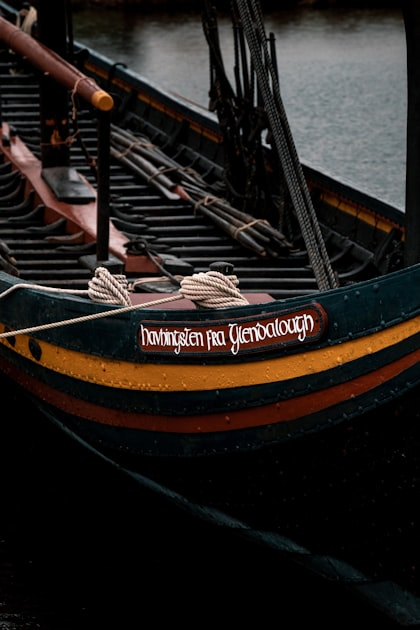
Preserving and understanding maritime heritage allows us to appreciate the extraordinary skill, courage, and ingenuity of those who came before us. The Gokstad ship is not merely an artifact; it is evidence that nearly 1,100 years ago, Norse shipwrights possessed the knowledge to build vessels capable of crossing oceans, a feat that would not be widely accepted until a full-scale replica proved it in 1893.